Starbucks, a multi-national coffee chain, has made environmental principles one of its main priorities, which has evoked both criticism and applause from environmentalists. Were Starbucks’ global environmental goals created for PR purposes? Or does the coffee giant actually care about the saving the planet?
LEED Certified Stores
Starbucks has been a leader for more than a decade in the development and implementation of a scalable green building program. It joined the U.S. Green Building Council (USGBC) in 2001 and collaborated with them to develop the LEED for Retail program, an effort to adapt LEED to new construction and commercial interior strategies for retail businesses. Starbucks later became one of the first retailers to join USGBC’s LEED volume certification pilot program.
The first LEED-certified Starbucks store opened in 2005 in Hillsboro, Oregon, and it just opened their 500th LEED store in Disney World. The environmental features of the latest store include the use of reclaimed oak, maple and other materials used throughout the store as well as the community tables, which are made from salvaged trees. All of the lighting is energy efficient LED and the green roof is planted with hundreds of lemongrass plants fertilized with coffee ground compost. The store also features a moss art installation by Miami-based Industrial designer and artist Paloma Teppaa. Finally, the store also features a Starbucks Reserve Store that serves up rare and exquisite small-batch coffees from around the world.
Starbucks now have LEED-certified stores in 18 countries. Starbucks’ latest LEED progress report, however, seem to project figures that don’t really correspond with its goal. The percentage of new company operated stores built to achieve LEED certification has decreased:
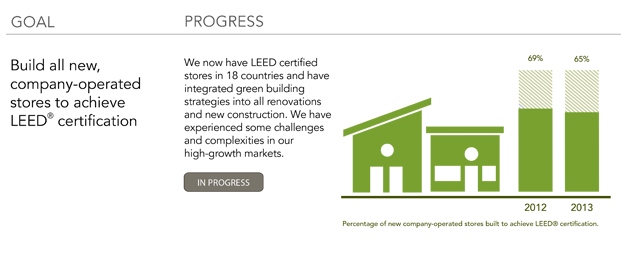
How is Starbuck’s LEED certification status currently looking? It has certified 373 stores in 18 countries. Six stores are in Thailand, including Porto Chino which is the first LEED Gold store for Starbucks in all of Asia. This store includes the use of recycled coffee grounds in table tops, low emitting materials for adhesives, sealants, paints, coatings and flooring, over 10% of materials extracted within 500 miles and over 45% lighting power savings through the use of efficient LED fixtures.
Energy Conservation
Starbucks claims that by building more energy-efficient stores and facilities, conserving the energy and water they use and purchasing renewable energy credits, it is “pushing” itsef to reduce the environmental footprint of their business operations. Starbucks have set a goal to reduce energy consumption by 25% and to cover 100% of electricity consumption with renewable energy by 2015. Here is how that’s looking:
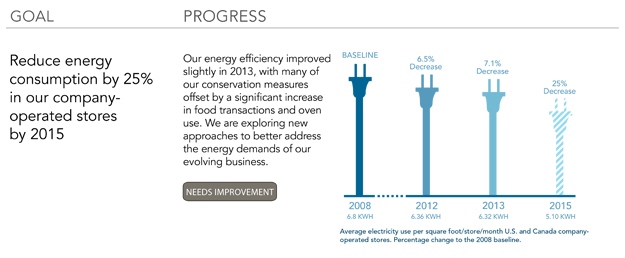
Figures show that electricity use has decreased by 7.06% from the 2008 baseline. Starbucks say: “Although we are pleased to see our electricity use decrease, we need to continue to make improvements and innovate new solutions in order to further our goal of improving the energy performance of our stores.”
Renewable Energy
In 2008 Starbucks set the goal to purchase Green-E certified Renewable Energy Certificates (RECs) equivalent to 50% of the electricity used in U.S. and Canada company-operated stores. That goal was achieved in 2010, so in 2011 Starbucks began working toward a goal to purchase the equivalent of 100% of the electricity used in company-operated stores globally by 2015.
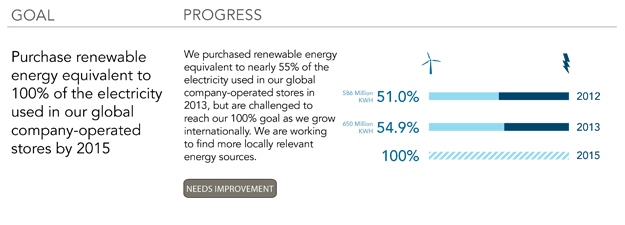
Data shows that in 2013, Starbucks increased renewable energy certificate purchases 7.6% over 2012 levels, equivalent to 54.9% of the electricity used in our stores globally. The U.S. Environmental Protection Agency has named Starbucks among the top 10 purchasers of renewable energy in the US.
Criticism
1) The coffee industry can never really be sustainable. Starbucks has been criticised because of water wastage. It was revealed that water ran continuously on dipper wells, which are used to wash utensils. This added up to an estimated 6.2 million gallons of water wasted each day. Coffee has a high water footprint- to produce one cup takes 140 litres of water. It is also cultivated in tropical countries where soils are vulnerable to erosion and loss of topsoil.
2) Historically, much coffee was shade grown under a variety of native trees on small farms. A surge in coffee demand a decade ago significantly increased global production, thus boosting the prevalence of monoculture farming. The land is often cleared of native vegetation and pesticide use became more common.
3) The profits made by farmers became much more volatile when global production of coffee swelled a decade ago. As the markets were flooded with coffee, prices plummeted. This created an economic hardship for those who depended on cultivation for their livelihood.
4) Coffee shops depend on the consumption of large amounts of fossil fuels and natural resources. Most Starbucks stores are located in areas where coffee is not cultivated, thus coffee must be transported thousands of miles.
5) Starbucks stores use billions of cups annually by offering disposable paper cups to all customers regardless of where the beverage is consumed. This requires enormous quantities of natural resources and energy before finding their way to landfills.
Although much criticism is true, Starbucks caring about the LEED status of its buildings, recycling & reducing waste, and climate change means other big corporations will probably follow suit, meaning that there’s a chance the world may be one step closer to becoming a more sustainable and green place to live.
To take a look at the details yourself, here is the latest Global Responsibility Report Goals & Progress.