The two-year study, which took place in a sample of houses, schools, offices and retail spaces in Townsville and Brisbane, found that white roof coating reflected 88percent of the sun’s energy, Architecture & Design reported.
In contrast, standard roofs of a light colour reflect less than 65percent of solar energy, while dark roofs will reflect less than 25percent.
Researchers reported a 2°C drop in air temperature in rooms that weren’t air conditioned. The findings suggest that companies can save on energy costs by painting their roofs with the special coating rather than investing in expensive air conditioning units.
Professor John Bell, head of QUT’s School of Chemistry, Physics and Mechanical Engineering, said: “We saw average energy savings of between five and 30percent across the range of buildings, with most buildings showing savings above 15percent.
He continued: “It really is an extraordinarily simple solution. Twenty years ago it was cheaper and easier to put in an air conditioner than to paint your roof, but not anymore.
“Unlike air conditioners this is a passive cooling solution that does not require ongoing investment in the electricity network or in housing. Because of this, it would be a worthy candidate for inclusion in the building regulations much as they have done in the California energy code since 2005.”
]]>The CBRE’s Green Building Adoption Index ranked Minneapolis-St. Paul for the second year running – with more than 70 per cent of its commercial office space holding a certification from either the Environmental Protection Agency’s Energy Star program or the US Green Building Council’s LEED standard.
The US national average equals just 38.7 per cent.
CBRE’s Green Building Adoption Index top 10:
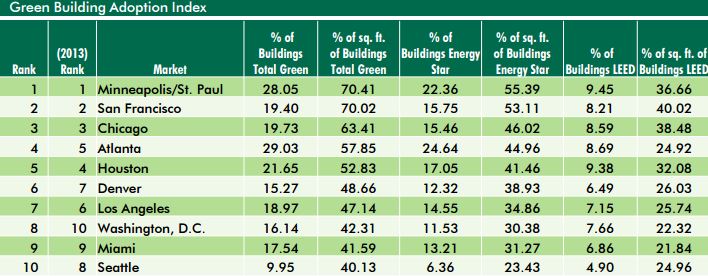
Click table for full list
The index ranks US market based on two the total number of office buildings, and total office square footage.
Competition for the best talent is a driving factor behind companies achieving green status, suggest the reports authors.
“With 18 Fortune 500 companies located in the Twin Cities, competition is fierce to attract and retain the best young talent. Knowing that this young talent is passionate about the environment, many of these companies strive to occupy green buildings,” the study says.
]]>On the 29th June, the Solar Impulse took off from Japan at 3.00am local time in an attempt to travel to Hawaii. The solar powered aircraft had been stuck in Japan for over a month due to unfavourable weather.
The Solar Impulse is powered by 17,000 solar cells that are attached to the wings of the plane. The plane symbolises the improvements made in solar powered travel, although commercial flights on clean-energy planes are still a long way away.
The journey to Hawaii is expected to take 5 days in total, and Swiss pilot André Borschberg has no choice but to continue his journey after passing the ‘point of no return,’ meaning that there is no place where the plane can make an emergency landing.
On March 9th, Borschberg began his around the world journey in Abu Dhabi. Now in its eighth leg, the Solar Impulse will travel to Phoenix after it reaches Hawaii, then journey across the United States before it reaches Europe. The plane is expected to complete its expedition in Abu Dhabi later this year.
‘‘Now fully into the flight to Hawaii,’’ Borschberg tweeted to his 13,000 followers. ‘‘Very strong emotions as I passed the point of no return: exploration starts here.’’
]]>
The Fitzpatrick Center for Interdisciplinary Engineering, Medicine and Applied Sciences caused 85 bird deaths during three 21-day surveys during the peak migration period spanning 2014-15, and another study ranks Duke the highest out of 45 campuses in bird collision figures.
Nicolette Cagle, a lecturer at the Nicholas School of the Environment, supervised the bird-collision surveys. She told the The News & Observer that seven buildings in the surveys were chosen according to methodology used by Augustana College researchers in their nationwide project and did not originally consider environmental certification or “green” design as a factor. “Because these energy-efficient buildings often have requirements for ‘green views’ and natural light, they often have high glass proportions,” Cagle said.
Steve Hager, an Augustana professor involved with the study, said in an e-mail to The News & Observer that there is a strong correlation between bird deaths and buildings with lots of glass. “Research we published in 2013 … strongly suggests that the number of bird-window collisions is super high at buildings with high amounts of sheet glass.”
]]>Terri has moved from her former role with the C40 Cities Climate Leadership Group, where she oversaw the restructure of the Clinton Climate Initiative cities technical assistance program, and spearheaded the development, fundraising and implementation of the network strategy. Her previous experience also includes serving as the London City Director for the Clinton Climate Initiative, working with the London Mayor’s Office to scale up the award-winning RE:FIT retrofit program and laying the groundwork for the city’s Building Energy Challenge.
“We’re sure that Terri’s experience and skill will take the WorldGBC to the next level, increasing our global impact and driving the change towards sustainability in the built environment worldwide. We’re looking forward to working with her to build on our past successes and accelerate the difference we’re making to the green building world”, the WGBC commented.
]]>
According to Aliwassa Pattanathabut, Managing Director of CB Richard Ellis (Thailand), office tenants increasingly prefer Leadership in Energy and Environmental Design (LEED) certified buildings, which can bring developers between 10 and 20 per cent higher rents.
Multinationals including Citibank, Unilever and L’Oreal have completed LEED fit-outs in their Bangkok offices, while all new Starbucks retail branches will have certified interiors.
According to Thanapol Sirithanachai, President of Golden Land Property Development, most multinational firms looking to expand their overseas investment have a policy of operating out of green buildings, prioritising the increased efficiency and employee wellbeing over the cost savings a non-certified building would represent.
While a number of new LEED-certified projects are currently underway in Bangkok, according to Aliwassa older buildings present ample opportunity for refurbishment.
She said: “Most multinational firms that expand their investment in the region have a policy to rent green office space as the first priority. When office owners are interested in new green building or renovating their office space as a green building, that will open up business opportunities to get these tenants and also generate higher income over the long term.”
]]>Willis joins WorldGBC from her current role as director of global initiatives with the C40 Cities Climate Leadership Group, where she oversaw the restructure of the Clinton Climate Initiative cities technical assistance programme. She also spearheaded the development, fundraising and implementation of the network strategy.
Willis previously served as the London city director for the Clinton Climate Initiative; worked with the Government of Ontario on clean technology development; project managed Civic Action’s Greening Greater Toronto initiative which created the Race-to-Reduce building retrofit program; and worked for the BBC.
She will start her new role on June 1st, taking over from CEO Jane Henley, who left the WorldGBC in March after five years.
“We’re delighted to welcome Terri as our new CEO,” said Bruce Kerswill, chairman of WorldGBC. “The green building movement is growing apace – we have GBCs in 100 countries across the globe and the WorldGBC continues to grow in size and influence.”
“Terri’s experience and drive will take us to the next level, boosting the services we offer our members, increasing our global impact, and driving the change to sustainability in built environments globally,” he added.
]]>
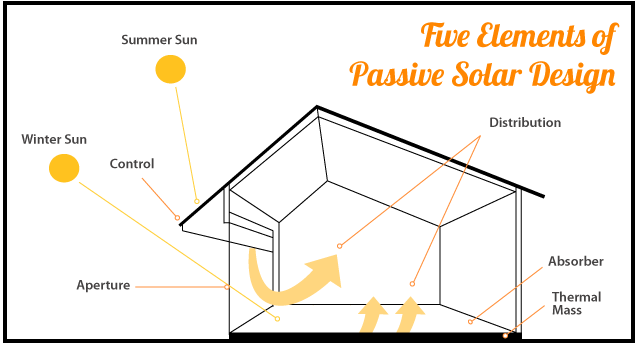
image via
In passive solar building design, windows, walls, and floors are made to collect, store, and distribute solar energy in the form of heat in the winter and reject solar heat in the summer. This is called passive solar design because, unlike active solar heating systems, it does not involve the use of mechanical and electrical devices.
]]>
It is forecast that by the end of 2015 there will 32 operational biomethane to grid projects, set to increase production substantially. It is expected that 32m therms of biomethane will be injected into the gas grid this year, compared to just 300,000 in 2012.
The 28 biomethane plants currently in operation have the capacity to produce enough energy to meet the heating and cooking needs of more than 100,000 homes, and biomethane is increasingly used to power HGVs and buses. The fuel’s popularity has been bolstered by the government’s Renewable Heat Initiative.
According to James Baldwin, managing director of CNG services: “Biomethane, made from waste, is a perfect renewable fuel as it can be seamlessly incorporated into our existing energy network and also works as a vehicle fuel for HGVs and buses. Growth of biomethane since the first Biomethane Day has been spectacular.
He continued: “Next year biomethane plants will be injecting over 2.3 billion units of gas into our gas grid. That’s the equivalent of three 60,000 tonne LNG tankers not needing to dock at our ports. And the future looks bright, whatever the result of the General Election is. We know all main parties support biomethane.”
]]>